Delegates
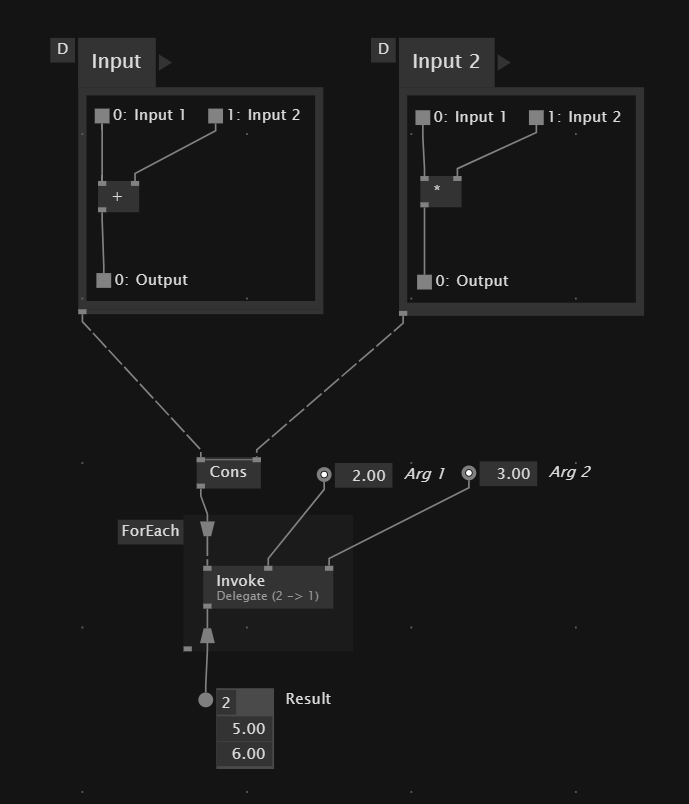
Delegates are anonymous operations which can be passed around as an object and can be invoked on data when needed.
The fact that a delegate doesn't have a name is a feature here: as long as it has the correct signature it will fit, like a lego piece with the right shape. This way you can treat behaviour as an object which can be used to easily switch between different functionalities - without changing the calling code downstream. The delegate abstracts away the internals and only presents a facade.
Delegates have zero to many inputs, and zero or one output. This is part of what defines the signature, or "shape". They are a standard .NET feature.
Inputs are called parameters in the definition, and on the invocation side the values passed in are usually called arguments.
Defining a delegate
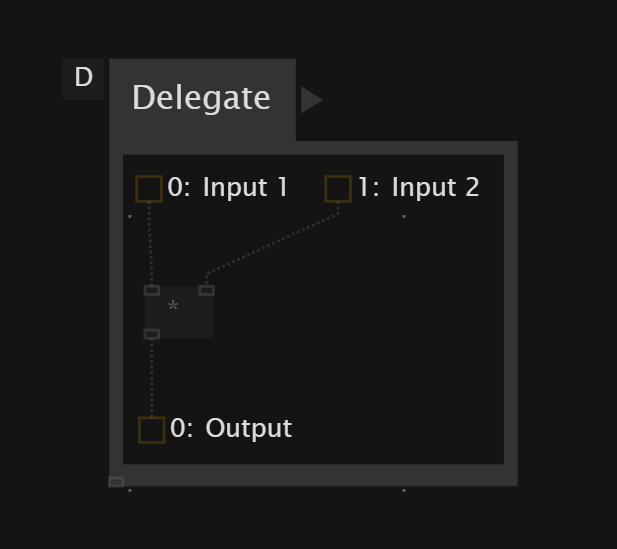
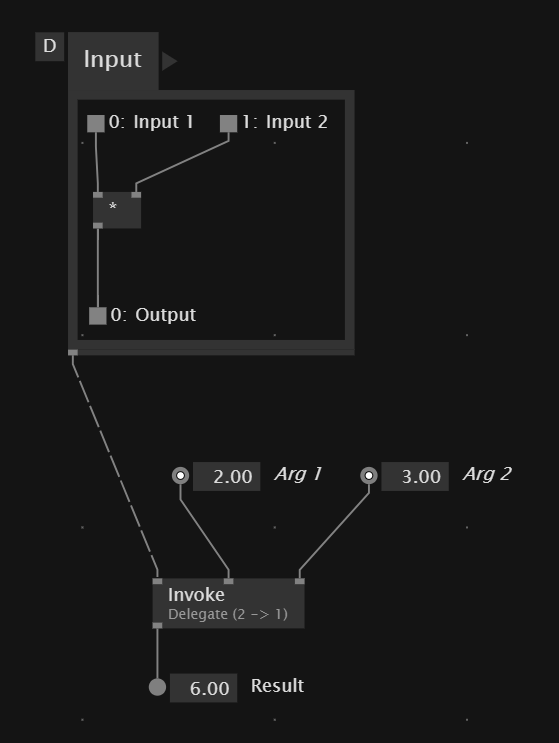
A delegate is defined using the Delegate region. It will initially be empty, so you will want to add inputs and/or outputs to have it actually do something. Here we have a delegate which takes two parameters, multiplies them, and then outputs it. Note that this code is not yet being executed.
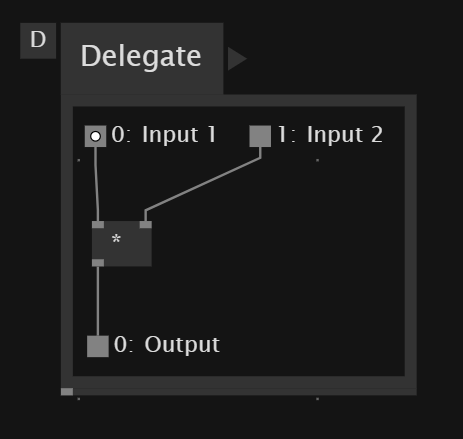
We can assign types to the in/outputs by right-clicking on them and selecting "Configure". Here we have set the first input as a Float32 as denoted by the white dot, which will propagate to any other applicable generic types.
Invoking a delegate
To actually execute the code we have written, we need to invoke the delegate. On the output pin of the delegate, you will notice the type is something like (T1, T2 ...) -> (T). You will need to match the number of parameters to the signature of the Invoke node you use.
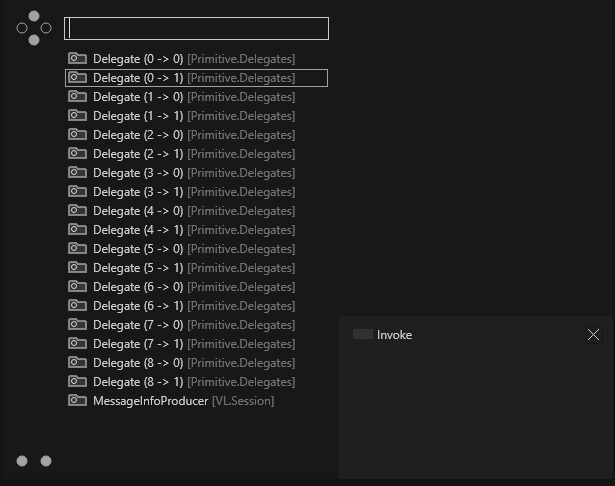
You can now execute the delegate and pass it parameters through the Invoke node. Note that this specific delegate has no types specified - they got inferred via the usage.
As delegates are objects, you can for instance store them in a spread and choose which to execute programmatically.